

“Absolute pleasure to have Jav teaching boxing & self-defence as part of our event. Cannot recommend him highly enough!
Thanks so much, Jav. We loved having you as part of the event, as did all the young people you worked with so brilliantly.”
(Maria Flude, Senior Health & Volunteering Project Coordinator. Reach South Sheffield).

“Thank you for the self-defence session with the girls, you had a full age range from 12-19 years! They had a great time, with a lot of laughs, supporting one another and learning a new skill, which was great to see.
Your supervision of the session was both professional and enjoyable and was evident from the amount of noise and laughter that came from the group. Thanks again.”
(Nichola Mills, Engagement Worker, VIBE Together Women).

“I really enjoyed your boxing sessions whilst studying for my masters. It definitely helped me in achieving a distinction. Keep up the good work!”
(Fadi Ford, Field Marketing Manager. Egnyte).

“11 young people and 6 youth workers took part in well-being, self-defence & boxing workshops run by the wonderful Javeed Khan. 99% of those who attended felt there knowledge had increase!
(Kerry Nichol, Lead Youth Worker. Wakefield Council & Horbury Breakthrough Youth Project).
Overall we’ve had a great day!”

Boxing and Defence
For individuals 1-to-1, groups, families, friends, and employees.
Available in your own home / school / workplace / local park setting / birthday or event!
+ Non-contact sessions, meaning: no one gets hit or hurt. You will strike pads and bags, learn many techniques and enjoy in a safe and friendly environment!
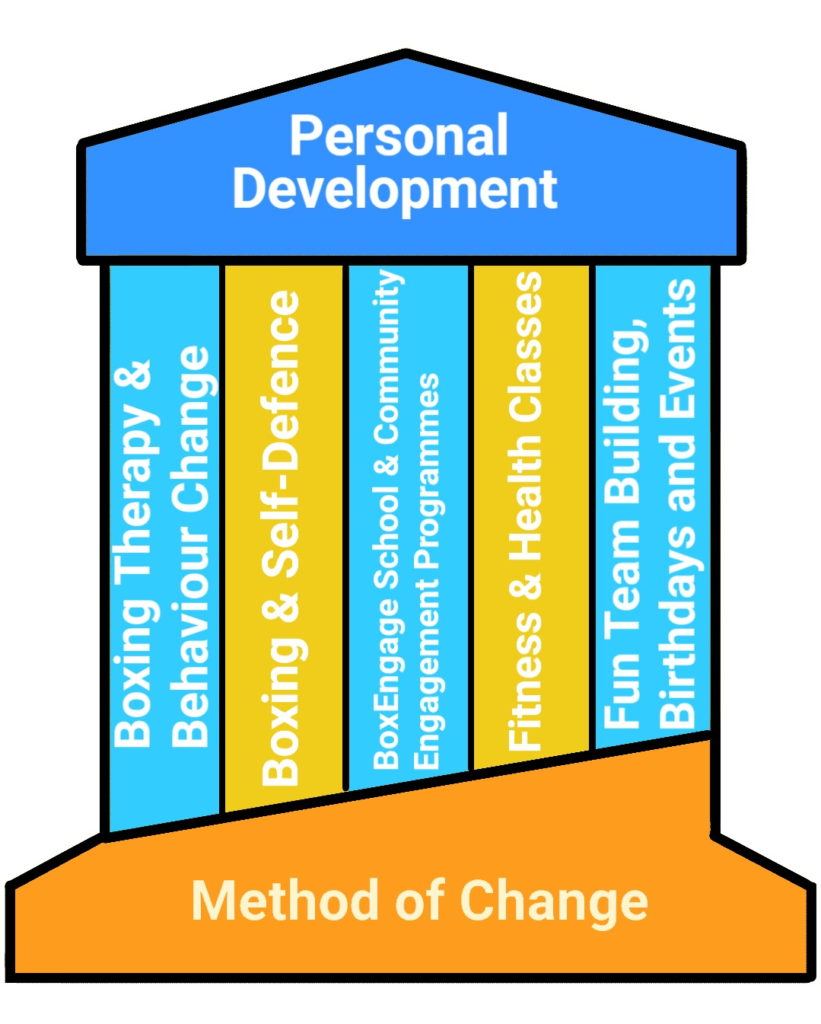
1. BoxEngage school and community engagement programmes (Integrated boxing, education, wellness, counselling and mentoring)
Our BoxEngage school and community engagement programmes exist to improve mental health and emotional wellbeing, increase attendance and engagement, facilitate exploration of issues, improve relations between peers and staff, increase cognitive functioning and support learning. The links between boxing exercise and anxiety, anger, stress, violence and depression reduction are well documented. Furthermore, neuroscience has proven that the less-anxious brain is able to concentrate longer, learn better, and retain more information, in comparison to the brain of one experiencing anxiety. Therefore, demonstrating the value for investing in anxiety and trauma symptom reduction methods (Professor Richard Davidson 2010).
Boxing engagement programmes provide an effective platform to facilitate healthy psychological thinking and behaviour change, learn boundaries, manage emotions and wellbeing, deter people from drugs, alcohol, crime, and enable achievement.
Boxing supports emotional transitions. It provides a positive emotional outlet for natural adolescent testosterone increase therefore, preventing and reducing aggression levels. It teaches attributes, values and ethical code, which positively shapes behaviour.
Research evidences boxing as resourceful for prevention and intervention of violence and other crimes. Social capital and community cohesion are additional benefits of boxing. Research also highlights the following benefits of boxing exercise programmes:
- Increases brain functioning, and slower cognitive decline
- Improves attention, concentration, learning and memory functions
- Increased focus in school
- Development of respectful relationships, and resolves social exclusion
- Nurtures developmental needs
- Increased self-esteem and confidence
- Promotes positive introspection and self-improvement, including self-belief, self-worth and discipline
- Positive sense of identity
- Engagement with positive support networks
- Provides a platform for further learning, education, wellness, counselling and mentoring support, and a reflective relationship
- Teaches respectful debate, conflict prevention/resolution, safety and problem solving skills
- Improves impulse control and patience
- Participants collectively share their learned skills and ethics via a ripple effect
- Supports people to develop into successful adults
- Supports emotional transitions and promotes health
- Improves mental health and emotional wellbeing
- Assists development of self-actualisation
- A positive emotional outlet for natural adolescent testosterone increase therefore, preventing and reducing aggression levels
- Antidote to violent times
- Teaches attributes, values and ethical code, which positively shapes behaviour
- Motivates and assists attitude change, returns to education and employment
- Provides a suitable environment for natural adolescent risky behaviours
- Helps people overcome trauma, mistrust, anxiety, anger and depression
- A route out of violence and other crime
- “Boxing has unmatched capacity to engage the most disaffected in society” (Nicola Adams, Olympic Boxing Champion).
Cost Effective:
In comparison to paying £10,000 to refer a young person to a pupil referral unit, our programmes are both cost effective and outstanding at facilitating change.
Fees for individuals / groups / organisations:
Fees for BoxEngage engagement and cohesion programs are by negotiation based on your needs. Please contact us to discuss your requirements. Questions are always welcome.
Please contact me directly on 07599922679 to book a free complimentary initial consultation.
I look forward to speaking with you.
Warm Wishes,
Javeed.
2. Boxing Fitness and Health Classes (providing 1-to-1 and group sessions – Promoting mental, social and physical wellness)
Boxing exercise provides numerous health benefits. These include mental, emotional, physical, social, and brain development benefits.
Mental Benefits:
The scientific community hold a growing interest in the link between physical and mental fitness, as well as empirical evidence of the many mental health benefits of regular exercise. Research of the link between exercise and depression involving participants who were all suffering from depression, were divided into three groups. The first group was prescribed anti-depressants, the second aerobic exercise, and the third a combination of anti-depressants and exercise.
Four months later, for the majority of participants their depression had improved. But the real surprises was that after 10 months, 38 percent of those in the anti-depressants group and 31 percent from the combination group (anti-depressants plus exercise) had relapsed, whereas only 9 percent of those who did exercise alone became depressed again. These results suggest that physical exercise is a very powerful way to deal with certain mental illnesses and to maintain good mental health (Grenville-Cleave).
Boxing exercise increases brain functioning, and promotes slower cognitive decline. It furthermore improves attention, concentration, learning and memory functions. Recent research demonstrates that exercise helps to create new brain cells (neurogenesis) in the areas of the brain which are known to shrink when people have mood problems. This is the case even in older adults, that mental wellbeing in later life can be improved through physical exercise. The University of Illinois (2005) research found that elderly people (average age 67) who were physically active also had more active brains, better mental skills and better memory than those who weren’t physically active. The researchers then divided elderly people into two groups, one which participated in exercise, and one which didn’t. They found that those who exercised increased their brain density compared with those who didn’t (Grenville-Cleave).
Psychology research demonstrates the sport provides a positive emotional outlet, teaches emotion management and self-control, improves sleep patterns, reduces emotional distress and promotes and enhances holistic wellbeing (Grenville-Cleave). Boxing is a proven method for regaining a sense of control, reducing symptoms of stress, anger, anxiety, mistrust, depression and dissociation (strong feelings of disconnection from reality; dissociation is often experienced after suffering a trauma). Boxing exercise is documented as extremely helpful for trauma recovery as detailed above in section 1. Confidence, self-esteem and a positive self-image develops greatly from participation in boxing; qualities which are transferrable to personal, academic and professional settings. Boxing promotes positive introspection and self-improvement, including self-belief, self-worth and discipline. It improves impulse control and patience.
Integrated boxing and therapy programmes provide an influential platform to explore thoughts and feelings, and facilitate rational thinking, emotional processing, emotional outlets, and behaviour change. Furthermore, the body’s natural production of endorphins through physical exercise is strongly evidenced as an effective method for combating depression, and experiencing a strong sense of happiness.
Boxing supports emotional transitions. It provides a positive emotional outlet for natural adolescent testosterone increase therefore, preventing and reducing aggression levels. It teaches attributes, values and ethical code, which positively shapes behaviour.
Neuroscience and Exercise Findings (Dr Alex Korb):
Your brain is interconnected with your body, so the things you do with your body affect your neurochemistry. Your brain does not like being idle; it comes with a body, and it wants to use it. Exercise is possibly the most straightforward and powerful way to start an upwards spiral (to combat depression). Exercise has many of the same effects on the brain as antidepressant medications and even mimics the buzz of recreational drugs. Yet exercise is natural, it causes more nuanced and targeted brain changes, and its benefits can exceed even those of medication. Exercise is very good for the brain–specifically, for the circuits that keep you depressed. Almost everything that depression causes can be combatted by exercise. For example:
- Physically – depression makes you lethargic and tired, yet exercise gives you more energy and vitality.
- Sleep – depression messes up your sleep patterns, yet exercise improves your sleep, making it more restorative for your brain.
- Eating disorders – depression wreaks havoc on your appetite, so you either eat too little or binge eat on junk food, (and people who eat lots of processed foods are at higher risk for depression). Exercise improves your appetite, leading to more enjoyable eating and better health.
- Mentally – depression can make it hard to concentrate, but exercise makes you mentally sharper and better at planning and decision making.
- Depression makes you intensely sad, but exercise improves your mood. It also reduces anxiety, decreases stress, and boosts self-esteem.
- Socially – depression usually keeps you isolated and alone, but exercise helps to bring you out into the world.
Furthermore, all of these effects make it more likely that you’ll engage in other activities and thought processes that also reverse the course of depression. For example, exercise improves sleep, which then reduces pain, improves mood, and increases energy and alertness. Then reduced pain makes you more likely to exercise and increases your enjoyment of exercise. The take-home message is that all these causes and effects intermingle and build on each other in an upward spiral towards feeling better.
Steroids for Your Brain
Just as exercise strengthens your muscles, it also strengthens your brain. Exercise increases nerve growth factors, such as brain-derived neurotrophic factor (BDNF), which are like steroids for your brain. BDNF makes your brain stronger, so it’s more resistant to all kinds of problems, not only depression.
Numerous studies have demonstrated that exercise causes growth of new neurons. In one study, a pair of Texas scientists looked at the effects of exercise on rats. The rats were divided into three groups: voluntary running, forced running, and controls. Those in the voluntary running group were allowed to run at whatever speed they felt like, while those in the forced group had to run at a set speed. The controls weren’t allowed to run at all.
The study showed that both exercise groups had greater development of new neurons in the hippocampus. However, the voluntary group had more new neurons than the forced group, which suggests that actively choosing to exercise provides more benefits than being forced to. Exercise helps create the conditions for all kinds of beneficial growth, but you’ve got to keep it up and give it time to work.
Pumping Up Your Serotonin
The relationship between exercise and antidepressants doesn’t end with neuron-strengthening BDNF. Most antidepressants target the serotonin system and elevate serotonin levels, which increases mood, motivation and willpower. Well, it turns out that exercise can also boost serotonin activity. Movement increases the firing rate of serotonin neurons, which causes them to release more serotonin. And when more serotonin is released, more is produced to keep up with demand.
Importantly, serotonin and BDNF are particularly good at creating an upward spiral against depression, because serotonin stimulates the production of BDNF, and BDNF strengthens serotonin neurons. Exercise sets the snowball in motion, and the brain’s dynamic interactions keep it going.
Energise Your Norepinephrine
The difficulties with concentration and deep thinking that often accompany depression are mainly the fault of a lagging norepinephrine system, which is why, next to serotonin, norepinephrine is the neurotransmitter most commonly targeted by antidepressant medications. Fortunately, exercise increases norepinephrine as well. A study in Germany had subjects either rest, jog slowly, or sprint at high speed. While all exercise increased norepinephrine, intense exercise was particularly helpful. So if you can find the energy to push yourself, your brain will make it worth your while.
Reward Yourself with Dopamine – And Increase Willpower to Overcome Harmful Addictions
Dopamine is your brain’s version of methamphetamines. The dopamine circuit in the brain controls aspects of pleasure, decision making, and focus. It’s the primary neurotransmitter behind addiction. All those addictive drugs called “uppers,” like cocaine or crystal meth, are basically jacking up your dopamine. In fact, any addiction-not just to drugs, but also risk taking, or emotional drama etc.-simply robs the brain’s natural capacity to enjoy things. Dysfunctional dopamine explains the lack of enjoyment that often accompanies depression. Fortunately, the dopamine system is positively affected by exercise.
A group of British scientists examined cigarette cravings in smokers before and after exercise. After not being allowed to smoke for fifteen hours, the participants were divided into two groups: an exercise group and a control group. The exercise group completed ten minutes of exercise at light to moderate intensity, while the control group just sat there.
When subsequently examined in a functional MRI scan, the control group had a predictable brain response to looking at cigarettes. They showed increased activity in the orbitofrontal cortex, which is part of the ventral prefrontal cortex and is involved with motivation. They also showed significant activation in the dorsal striatum. Both of these regions are influenced by dopamine activity. In other words, their brains really wanted those cigarettes and were activating habits to do something about it.
On the other hand, the exercise group had a different brain response to looking at cigarettes. Remember the two groups were exactly the same except for a ten-minute period of exercise. Yet the exercise group after their exercise, showed decreased activity in those brain areas-their brains wanted the cigarettes less. Just ten minutes of exercise had significantly altered their dopamine circuits and increased their willpower.
The Natural High
Natural neurochemicals or illegal street drugs? Sometimes it’s hard to tell. Exercise causes your brain to release endorphins, neurotransmitters that act on your neurons like opiates (such as morphine or Vicodin) by sending a neural signal to reduce pain and provide anxiety relief. Exercise causes your brain to release endorphins, and these changes correlate with improving people’s mood.
Endorphin release is the highest during intense exercise. Motivation and decision making, planning and thinking, reduced pain perception, focus, and depression reduction, are all areas improved by exercise.
Calming Your Stress Hormones
The relationship between stress and depression is a two-way street: depression is stressful, and stress pushes you towards depression.
Exercise can help.
A collaboration of Japanese and Thai researchers looked at the effects of exercise on stress in a group of depressive teenage girls. After eight weeks of exercise on weekdays, exercise dramatically reduced their stress hormones (cortisol and adrenaline) and depression, and improved their physical health and social relationships.
Increasing Blood Flow in the Prefrontal Cortex
While most neuroscience studies compare brain activity before and after exercise, a group of researchers in Tokyo wanted to look at brain activity ‘during’ exercise. While subjects exercised, they experienced increases in oxygenated blood in the ventral prefrontal cortex, accompanied by improved moods and increased energy levels.
Sitting is the new smoking. In other words, it’s bad for you. If you sit at a computer all day, stretch frequently, and seek out ways of including some exercise in your day.
Exercise for Better Sleep
People with depression show increased amounts of REM sleep, which means their sleep is not as restful. Antidepressant medications reduce REM sleep, as does exercise. So, exercise, sleep more deeply, feel happier and more energetic, want to exercise more, rinse, repeat.
Overcoming Negative Inner-Speech
One of the greatest obstacles to exercise is that people with depression don’t feel like doing it. Thinking about exercise is often accompanied by automatic negative thoughts like ‘Oh, that’s not going to help.’ But that’s just because the depressed brain is stuck in a depressed loop and doesn’t know how to get out.
Remember exercise is going to cause tons of positive brain changes. It will modify circuits, release positive neurochemicals, and reduce stress hormones.
Your depressed brain might be telling you to give up. It might be telling you that everything hurts too much to exercise. Thank it for its opinion, and go and enjoy some exercise (Dr Alex Korb).
Social Benefits:
The new positive social experiences that boxing provides are significant for nurturing developmental needs, providing a sense of belonging, overcoming social isolation and increasing confidence. These social factors are also evidenced as curative factors for trauma, stress, anger, anxiety, depression, dissociation and overcoming mistrust. ‘Positive social interaction activates brain circuits that help to combat depression’ (Dr Alex Korb). Our boxing programmes offer engagement with positive support networks, and are also highly effective in deterring people from drugs, alcohol and crime, and enabling achievement. The comprehensive social and life-skills that we teach are transferable to personal, academic and professional settings.
Physical Benefits:
Exercise is important for a healthy heart, reducing high blood pressure, maintaining a healthy weight, preventing obesity, and developing strong bones and muscles. Boxing is an excellent method for bolstering these areas of health. In addition to these multifaceted benefits, boxing teaches people to feel both psychologically and physically safe.
We also know that physical exercise changes the biochemistry of the body-brain, which changes moods and emotions, as well as promoting better cardio-vascular health, and oxygenation of the whole system (Dr Jim Byrne).
Fee per session (including initial assessment session):
Individuals
£40 for individual Adults, Children and Young People
£35 for Further Education & University Students and Low-wage Employed
Couples
£70 for Couples
Groups and Organisations
Fees for groups and organisations are by negotiation based on your needs. Please contact us to discuss your requirements. Questions are always welcome.
Please contact me directly on 07787413763 to book a free complimentary initial consultation.
I look forward to speaking with you.
Warm Wishes,
Javeed.